
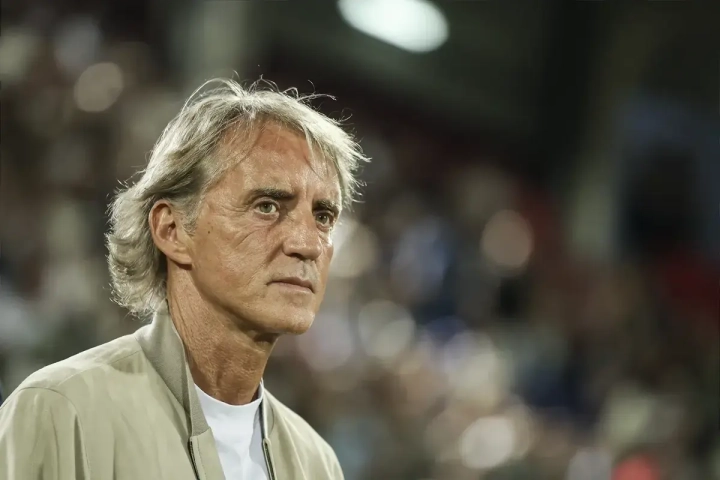
The Italian Football Federation (FIGC) has dramatically pulled Roberto Mancini out of the managerial wilderness, reappointing him as the head coach of the men’s national team just three years after his highly controversial departure. The sensational return of the 61-year-old tactician marks the culmination of an astonishing 48 hours of boardroom warfare in Rome, a period that saw a rival managerial deal publicly collapse, two legendary directors resign in protest, and the president of the federation seize absolute unilateral control of the rebuilding project.
As the dust settles on one of the most chaotic chapters in the modern history of the Azzurri, Mancini inherits a squad still reeling from the historic humiliation of missing a third consecutive FIFA World Cup. His mandate is unambiguous: guide Italy through the qualification cycle for the 2028 European Championship and secure their presence at the 2030 World Cup. However, the political environment surrounding his appointment is unprecedented in its toxicity.
The Collapse of the Pirlo Project
To comprehend the sheer magnitude of Mancini’s reappointment, one must examine the extraordinary events that unravelled over the past two days. Just 48 hours ago, former midfielder Andrea Pirlo was universally expected to succeed Gennaro Gattuso as the next head coach. FIGC technical director Paolo Maldini and senior advisor Leonardo had spearheaded the negotiations, viewing Pirlo as the ideal progressive candidate following failed approaches for other elite managers.
However, FIGC President Giovanni Malagò abruptly vetoed the agreement at the eleventh hour. The presidential intervention was triggered by severe political and public backlash regarding Pirlo’s commercial ties to Russian betting brands. Malagò concluded that appointing a manager with such sponsorships amidst ongoing geopolitical tensions, coupled with Italy’s strict domestic gambling advertising laws, would be a public relations catastrophe that the federation simply could not afford.
The Resignations of Maldini and Leonardo
The late veto fundamentally undermined the entire sporting department. Having staked their professional reputations on securing Pirlo, the legendary Milanese duo perceived Malagò’s actions as an unforgivable breach of their technical authority. Consequently, both Maldini and Leonardo officially tendered their resignations, plunging the federation into absolute administrative disarray.
Their departure removes two of the most respected figures in Italian football from the national setup, leaving a massive void in the strategic planning of Club Italia. The rapidity with which the project disintegrated highlights the fragile, highly politicised nature of modern football governance on the peninsula, where commercial optics frequently collide violently with sporting ambition.
The Ghost of Ancelotti and Guardiola
Before the Pirlo debacle consumed the federation, Maldini and Leonardo had ambitiously pursued the finest tactical minds on the planet. Maldini openly admitted earlier this week that their initial, dream target was Carlo Ancelotti. However, the veteran manager opted to remain steadfastly committed to his contract with the Brazilian national team, having recently signed an extension until the 2030 World Cup despite their own disappointing campaign in North America.
Following Ancelotti’s polite refusal, the FIGC delegation travelled to Barcelona to court Pep Guardiola. The 55-year-old Spaniard, freshly available following a decade of total dominance at Manchester City, listened to the proposal. Yet, the financial realities of Italian football proved insurmountable. Reports indicated Guardiola requested an annual salary of €20 million—a figure roughly double what the Italian federation was prepared to offer. With the primary targets exhausted, the pivot to Pirlo began, ultimately setting the stage for the week’s spectacular meltdown.
Malagò’s Power Play and Mancini’s Reinstatement
With the technical department decapitated and public outrage mounting over the sheer incompetence of the managerial search, Malagò was forced into a desperate corner. Rather than appointing a new technical director to lead a fresh, protracted search, the FIGC president executed a rapid, unilateral power play. He directly contacted Roberto Mancini, offering him the opportunity to return to the post he had controversially vacated in August 2023.
Mancini, who was a free agent after mutually terminating his contract with Qatari outfit Al-Sadd last month, immediately accepted the proposal. The sheer speed of the transaction, completed within hours of Maldini’s formal resignation, has led several prominent Italian media figures to openly speculate that Malagò had privately preferred Mancini all along, potentially using the sponsorship controversy to force Maldini’s hand.
To fill the immense administrative void left by the departing directors, the FIGC swiftly announced the appointments of former Leicester City manager Claudio Ranieri and veteran football administrator Gabriele Oriali. This vastly experienced pair will effectively assume the responsibilities previously held by Maldini and Leonardo. Their immediate task will be to shield Mancini from the intense political fallout, stabilise the youth academies, and provide a seasoned sounding board for the returning manager.
A Complicated Legacy
For Mancini, this is a remarkable, highly unexpected homecoming. The Italian public holds deeply conflicting views regarding his legacy on the touchline. He undoubtedly remains the architect of one of the nation’s greatest modern triumphs, having masterminded Italy’s glorious, emotional run to the Euro 2020 title. His progressive footballing philosophy during that tournament successfully transformed a historically rigid Azzurri into a fluid, attacking powerhouse.
However, the immense goodwill generated by that Wembley triumph evaporated rapidly. Just months later, Mancini oversaw the disastrous playoff defeat to North Macedonia, which saw Italy shockingly fail to qualify for the 2022 World Cup. When he abruptly resigned in the summer of 2023 to accept a highly lucrative contract to manage the Saudi Arabia national team, many passionate supporters accused him of outright treachery. His subsequent Middle Eastern venture proved entirely underwhelming, concluding in October 2024, preceding his similarly brief, forgettable stint in Qatar with Al-Sadd.
The Monumental Task Ahead
Returning to the hallowed turf of Coverciano, Mancini must rapidly rebuild bridges with a disillusioned fanbase and a highly sceptical sporting press. He inherits a squad entirely bereft of confidence, carrying the psychological trauma of yet another failed World Cup cycle following Gattuso’s recent departure.
The immediate reality facing the 61-year-old is a daunting UEFA Nations League campaign. Italy must navigate a formidable group featuring traditional European heavyweights. These fixtures will serve as a brutally uncompromising testing ground. Mancini will need to immediately identify a new spine for the team, integrating emerging youth prospects while decisively phasing out the remnants of the old guard who have overseen the consecutive qualification failures.
Table: Roberto Mancini’s First Tenure as Italy Manager (2018–2023)
| Metric | Record / Details |
| Matches Managed | 61 |
| Wins | 37 |
| Draws | 15 |
| Losses | 9 |
| Win Percentage | 60.6% |
| Major Honours | UEFA European Championship (Euro 2020) |
| Notable Failures | Failed to qualify for 2022 FIFA World Cup |
During his initial tenure, Mancini heavily favoured a 4-3-3 formation that relied on deep-lying playmakers and aggressive, overlapping full-backs. The modern international game has evolved since 2023, and observers will be keenly watching to see if his time in the Middle East has altered his tactical dogmas. With Claudio Ranieri now operating above him in an advisory capacity, there is hope that a pragmatic, defensive solidity can be married to Mancini’s natural inclination for possession-based football.
The ultimate barometer of success for this second Mancini era will be securing qualification for the 2030 World Cup. By the time that tournament arrives, it will have been 16 years since Italy last participated in football’s premier global showcase, an unfathomable, unacceptable statistic for a nation boasting four World Cup titles to its name.
Giovanni Malagò has staked his entire presidency on this recycled appointment. The civil war within the FIGC may have concluded for now, but the arduous battle to resurrect the Azzurri’s shattered international reputation has only just begun.