
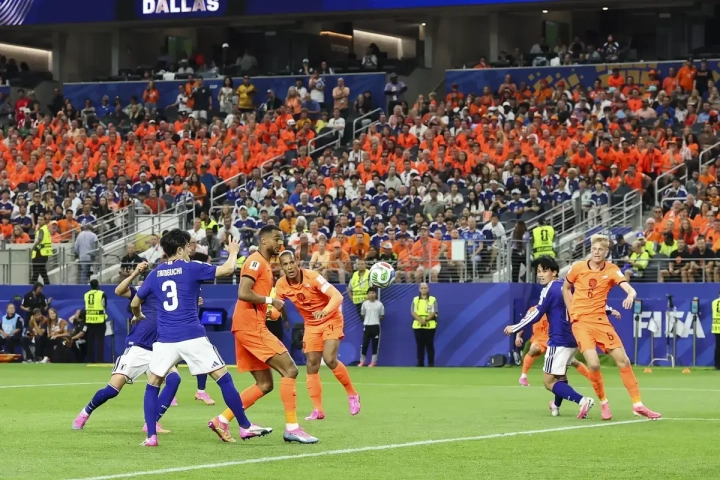
The Netherlands and Japan delivered one of the most absorbing matches of the World Cup so far as they shared a dramatic 2-2 draw in Dallas, a result that left both sides with mixed emotions after a Group F opener full of tactical detail, momentum swings and late drama. For the Dutch, it was a night that appeared to be moving towards a controlled and important opening victory after goals from Virgil van Dijk and Crysencio Summerville twice put them in front. For Japan, it became another statement of their resilience on the world stage, with Keito Nakamura and Daichi Kamada bringing them level on each occasion to secure a point that felt deserved by the final whistle.
The match began with the sense of two teams who understood the weight of the occasion. This was not a chaotic opening in which either side abandoned structure or chased early risks. Instead, it was a contest shaped by respect. The Netherlands, under Ronald Koeman, looked to build patiently from the back, using their defensive quality and midfield strength to try to draw Japan out of their compact shape. Japan, managed by Hajime Moriyasu, were disciplined without being passive, pressing in carefully selected moments and making sure the Dutch were rarely allowed to progress centrally without pressure.
The first half was goalless, but it was far from empty. It was a period in which both teams tried to solve each other rather than simply overpower the opposition. Japan’s defensive organisation was impressive, with their lines close together and their wide players prepared to track runners deep into their own half. Whenever the Netherlands attempted to work the ball into dangerous areas, Japan closed spaces quickly and forced them either backwards or wide. It was the kind of defensive performance that required concentration, timing and collective understanding, and it showed why Moriyasu’s side are so awkward to face in tournament football.
The Netherlands had moments of promise, particularly when Ryan Gravenberch found space to carry the ball forward or deliver from wider areas. Cody Gakpo looked capable of causing problems when drifting inside, while Denzel Dumfries offered width and power from the right. But the Dutch lacked a little sharpness in the final third during the opening period. Their approach was patient and measured, perhaps too measured at times, as Japan’s defenders repeatedly forced them into extra touches and delayed decisions.
Japan’s best moments before the interval came when they moved the ball quickly through midfield and attacked the spaces either side of the Dutch centre-backs. Daizen Maeda’s energy caused problems, while Ritsu Doan and Keito Nakamura were prepared to receive the ball under pressure and drive at defenders. Ayase Ueda also had a chance from a tight angle after finding a gap between defenders, but the effort went into the side netting. Nakamura, too, almost punished a moment of uncertainty when he controlled well at the far post before dragging a shot just wide.
That first half felt like a tactical arm wrestle. The Netherlands probably had the greater sense of authority in possession, but Japan created enough warning signs to show that the Dutch could not afford to become complacent. Bart Verbruggen had to stay alert in the Netherlands goal, while Zion Suzuki at the other end was called upon to deal with several crosses and set-piece deliveries. Neither goalkeeper was overwhelmed, but both had to remain switched on in a match where one lapse could easily have shifted the entire evening.
The game burst into life after the break. Whatever Koeman said at half-time appeared to sharpen the Dutch approach because the Netherlands emerged with greater tempo and purpose. They moved the ball faster, pushed their full-backs higher and began to make Japan defend closer to their own penalty area. The pressure told in the 51st minute, and it was a classic Dutch set-piece-style moment that broke the deadlock. Gravenberch, who was one of the Netherlands’ most influential players, delivered a fine cross into the area, and Van Dijk did what he has done so many times throughout his career. The captain found space, rose with authority and guided a powerful header into the far corner.
It was a goal that seemed to confirm the Netherlands’ growing control. Van Dijk’s finish had the calmness of a player used to big occasions, and the celebration carried the emotion of a captain determined to set the tone for his side’s tournament. For Koeman, it was exactly the type of breakthrough his team needed: a goal from leadership, physical dominance and quality delivery.
Japan’s response, however, was almost immediate. Rather than allow the setback to damage their belief, Moriyasu’s players increased their aggression and looked to attack more directly. Six minutes after falling behind, they were level. Nakamura, who had already shown flashes of danger, found room outside the area and struck a fierce low effort towards goal. The shot took a deflection on its way through, leaving Verbruggen with little chance. It may not have been the cleanest goal Japan will score at this tournament, but it was earned through their willingness to keep pushing and to keep asking questions of the Dutch defence.
The equaliser changed the emotional temperature of the match. The Netherlands, who had only just looked ready to take control, suddenly had to rebuild their rhythm. Japan, meanwhile, had fresh belief. Their supporters inside the stadium sensed that the match was opening up, and for a period the contest became far more stretched than it had been before half-time. The Dutch still had plenty of technical quality, but Japan’s speed in transition began to unsettle them.
Seven minutes after Nakamura’s equaliser, the Netherlands struck again. This time the goal came from Summerville, and it was a moment of individual quality that lit up the match. Gravenberch was again involved, feeding the ball into a dangerous area on the right side of the box. Summerville shifted inside onto his left foot and curled a superb finish across goal, the ball clipping in off the far post. Suzuki had little chance. It was a precise and composed strike from a player who seized his opportunity on a stage where reputations can change quickly.
Summerville’s goal restored Dutch control on the scoreboard, but it did not restore complete control of the match. Japan continued to play with courage. Moriyasu’s substitutions added energy, and the decision to introduce Koki Ogawa gave Japan another physical presence in the box. As the game moved into its final quarter, Japan began to commit more bodies forward, forcing the Netherlands to defend deeper than they wanted. The Dutch still carried a threat on the counter, and Gakpo nearly made the game safe when he cut inside and forced Suzuki into a strong save, but the pressure was increasingly moving towards the Dutch goal.
Koeman reacted by trying to protect the lead. The Netherlands adjusted their shape, with defensive reinforcements introduced and the team appearing to move towards a more conservative structure. It was an understandable decision in one sense; tournament openers can define the mood of a group campaign, and three points against a side as dangerous as Japan would have been hugely valuable. Yet the change also invited Japan to come forward with greater belief. The Dutch became less ambitious in possession, and Japan sensed that the match was not gone.
The decisive moment arrived in the 89th minute. Japan won a corner, and by then their attacks had a sense of urgency that the Netherlands were struggling to contain. Ogawa met the delivery with a strong header, and the ball deflected off Kamada on its way into the net. Verbruggen got across and made contact, but he could not keep it out. Japan’s players celebrated wildly, while the Dutch looked stunned. After leading twice, they had been pegged back twice.
For Kamada, it was the kind of goal that rewards persistence and intelligent movement. He may not have known everything about the final touch in the split second it happened, but his presence in the danger area was crucial. Japan had kept believing, kept attacking and kept forcing the Netherlands to defend uncomfortable situations. Their equaliser was not a fluke in the broader pattern of the closing stages. It was the product of pressure.
The final minutes were tense. The Netherlands tried to push forward again, but the momentum they had surrendered was difficult to recover. Japan, having rescued the match, were not content merely to survive, though they also understood the importance of not losing structure in stoppage time. Both teams had to balance ambition and caution, and when the final whistle came, the draw felt like a fair reflection of a match that had belonged to different teams at different moments.
Koeman’s thoughts after the game were likely dominated by frustration at game management rather than disappointment with the overall performance. There was plenty for the Netherlands manager to admire: Van Dijk’s authority, Gravenberch’s creativity, Summerville’s confidence and the way his side began the second half with real purpose. But there was also an obvious concern. Twice the Netherlands had the lead, and twice they failed to hold it. The late switch towards a more defensive shape will come under scrutiny because it coincided with Japan’s strongest spell of pressure. Koeman will know that his side showed enough quality to win, but he will also recognise that tournament football punishes teams who retreat too early or lose control of the ball in the final stages.
The Dutch manager will also be aware that the result does not damage their campaign beyond repair. A point against Japan is not a disaster, particularly in a group that was always expected to be competitive. But the manner of the draw will sting. The Netherlands had the experience, the lead and the momentum at key stages, yet they allowed Japan back into the contest. For a team with ambitions of going deep into the tournament, those details matter.
Moriyasu, by contrast, will take enormous encouragement from Japan’s mentality. His side were behind twice against one of Europe’s strongest teams and refused to accept defeat. The Japanese manager has built much of his team’s identity around discipline, adaptability and collective spirit, and all three qualities were visible in Dallas. Japan defended well in the first half, reacted positively after conceding, and became more dangerous as the match went on. Moriyasu will certainly see areas to improve, especially in how Japan handled Dutch pressure immediately after the interval, but he can also point to the courage his players showed when the game seemed to be slipping away.
The Japanese coach’s post-match reflections would naturally focus on survival and progression in a difficult group. Before the tournament, he had spoken about the toughness of Group F and the importance of finding a way through. This result gives Japan a platform. It does not guarantee anything, but it proves they can stand toe to toe with elite opposition and recover from setbacks.